Investing for your children
Having a kid? Thinking about saving money for their future needs such as driving lessons, university, or a deposit? Save some money for them!
In the UK, the main options are:
- Saving or investing in a Junior ISA. This puts the savings into your child’s name, and becomes accessible to them when they turn 18
- Saving or investing in your own accounts. This allows you to choose how much you give and when
Cash savings vs investments 💸
Section titled “Cash savings vs investments 💸”If your child is young, you should strongly consider investments over cash accounts, as over long periods stocks are very likely to outperform cash, and thus avoid inflation eroding your child’s savings.
An example over 20 years, contributing £100/month (£24,000 total contributed): cash savings averaging 1% below inflation would be worth £21,857 in real terms, while investments averaging 4% above-inflation growth would be worth £35,734.
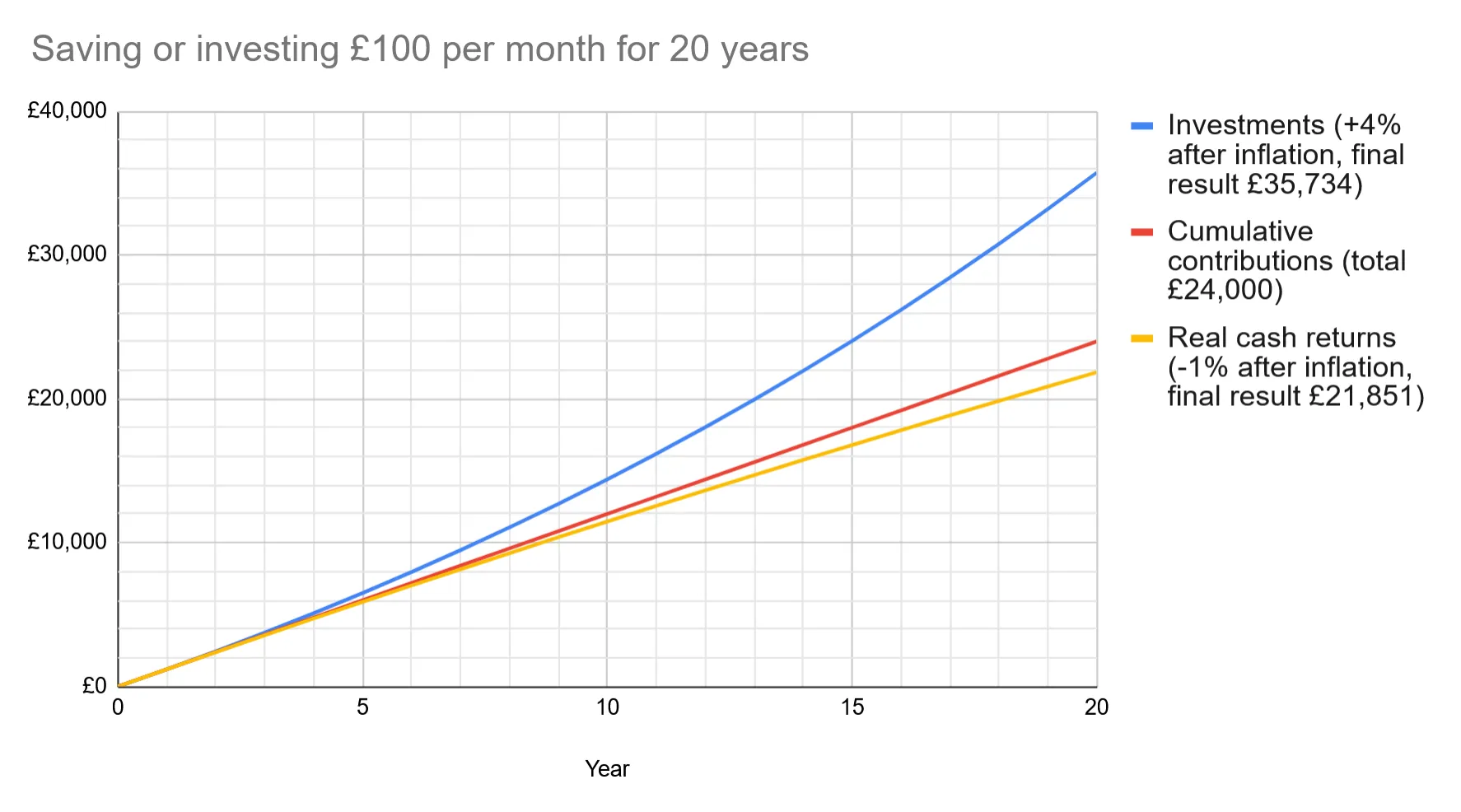
In general, if you are saving for goals more than 5 years in the future, it’s worth considering investing. If you’re new to investing, don’t be daunted! Start with our Investing 101 page and try our Recommended Resources for more in depth guides.
Account types
Section titled “Account types”Children’s Savings Accounts
Section titled “Children’s Savings Accounts”Suitable for: Short term savings for spending before age 18. Not suitable for: Longer term savings (>5 years), tax-free savings.
Many banks and building societies offer savings accounts for children. Money in children’s savings accounts is not locked away until the child turns 18, it can be spent at any age.
Interest earned in savings accounts is subject to tax. Whilst most children do not earn enough money themselves to pay income tax on their savings interest, money given to children under 18 by their parents or step-parents (but not other family members) earning £100 or more interest per year is subject to tax as if it was that parent’s savings. This prevents parents from avoiding tax on their savings interest by storing their savings in their children’s names.
As a parent saving for your children, there is no tax advantage to savings in your child’s account rather than your own. The only financial benefit is if the child’s account pays a better interest rate, which tends to be limited to introductory offers.
JISA (Junior ISA)
Section titled “JISA (Junior ISA)”Suitable for: Tax-free savings interest and investment growth, money for your child to receive when they turn 18, family members who want to save for a child’s future directly. Not suitable for: Money you want to reserve for a specific purpose (e.g. a house deposit).
Junior ISAs come in ‘Cash’ and ‘Stocks & Shares’ (investment) variants, much like regular ISAs, and follow similar rules.
Saving into a Junior ISA will not use any of your personal ISA allowance – your child has their own allowance, of £9,000 per year. In the tax year in which the child turns 18, they can use both their £9,000 JISA allowance and the standard £20,000 ISA allowance.
Only a parent or guardian can set up a JISA, but once it’s set up, other family members or friends can contribute money to it. The parent who opened it remains responsible for managing the account but cannot withdraw money from it.
When the child turns 16, they are given administrative control over the JISA, but cannot yet withdraw funds. On the child’s 18th birthday, the JISA becomes a standard adult ISA with no restrictions on withdrawals.
As such, you should consider how much money you would like to give your child access to at 18. If you are saving with the intention of this being a nest egg to help with a house deposit, you may wish to consider saving in your own name instead.
Your own ISA (or pension)
Section titled “Your own ISA (or pension)”Suitable for: Flexible help with education, home deposit, and other costs.
If you’d like to save money for your child’s future but not necessarily for them to have full access to spend at 18, you will need to keep the savings in your own name. This allows you to gift the money to your child at whatever point(s) you consider appropriate.
Be aware that in the event of your death these savings may be subject to inheritance tax – the money is legally yours. Similarly, if you ever need to claim means-tested benefits, savings in your name that you intended for your child will be treated the same as savings you intended for yourself.
How do I keep the money separate if it’s in my name?
Section titled “How do I keep the money separate if it’s in my name?”- Open a separate ISA or pension for your child’s savings
- Invest in different funds for your and your child’s savings
- If using a single fund, make a note of how many units were purchased each time you invest for yourself or your child
- Some platforms have functionality for dividing your investments into ‘pots’ and tracking them separately
You don’t have to keep all your savings in the same ‘pot’ – you can mix and match these strategies.
What if I want my children to have money they can’t access until age 21 or 25?
Section titled “What if I want my children to have money they can’t access until age 21 or 25?”Unfortunately, there is no easy and inexpensive way to put savings in your child’s name that do not become accessible to them when they become a legal adult. Any arrangement in which your child is the beneficial owner of these savings, but unable to access them at 18, is known as a relevant property trust in law, with complicated legal and tax arrangements.
The simplest thing is to either save in your own name (paying any applicable taxes), or to give the gift outright (via JISAs or other children’s savings accounts). If you are considering setting up a trust, you should speak to a private client solicitor and/or a financial planner – expect total costs to be in the thousands of pounds.
What if I just don’t tell them about their JISA until they’re old enough to use it responsibly?
Section titled “What if I just don’t tell them about their JISA until they’re old enough to use it responsibly?”The bank will contact your child about their JISA when they turn 16. It’s not legal to intercept this and continue running their JISA yourself. Money in a JISA belongs to your child and you should not contribute more to a JISA than you want them to have full access to when they reach 18.
Other account types
Section titled “Other account types”The account types below are unlikely to be useful in most situations – listed here for completeness.
Junior SIPP
Section titled “Junior SIPP”Suitable for: Helping your child save for retirement. Not suitable for: Living expenses, higher education, home deposit, etc.
If you want to give your child a head start on retirement savings, you can contribute £2880 a year into a JSIPP, which gets tax relief at 20% giving a maximum total contribution of £3600 a year. When your child turns 18 this becomes a regular SIPP with normal personal pension rules around access age.
The money does not compound any faster or better in your child’s JSIPP compared to your own SIPP, your ISA, or your child’s ISA – it is only that it remains inaccessible for the longest possible period of time. There is no specific advantage to setting up a JSIPP while they are under 18 rather than doing so when they are an adult. However if you are maxing out your own ISA and pension allowances, and already have as much in a JISA as you are comfortable with, this option is potentially worth considering.
Suitable for: Adult children saving for a deposit. Not suitable for: Children under 18.
Lifetime ISAs are available in cash and S&S variants, but you must be between 18 and 40 years old to open one – they cannot be opened on behalf of a child. You can of course encourage your child to open a LISA when they turn 18.
Children’s GIA
Section titled “Children’s GIA”If you have used your child’s full JISA allowance, you may be considering a GIA (taxable investment account) in your child’s name. This gets complicated as these need to be registered as trusts with HMRC, and are taxed differently depending on whether the funds came from parents (including step-parents) or others.
Premium Bonds
Section titled “Premium Bonds”Premium Bonds are tax-free, government-backed savings that provide “interest” in the form of a prize draw. Whilst in the past these were a popular choice to purchase for young children, on average they pay less than a standard savings account, so most people (especially anyone saving less than £5,000) would be better off saving elsewhere.