Retirement Planning
In the previous pension stage on the flowchart you made sure that you were opted in to your workplace pension, and we encouraged you to increase your contributions beyond the minimums.
However, that doesn’t guarantee you are saving enough for a comfortable retirement. To work out how much you may need to save takes a bit more research and calculation. If you are ready to start putting together a more detailed retirement savings plan, this page is for you.
This page assumes you have already addressed everything from our pensions page, and have spent some time setting financial goals.
How much should you save per month for retirement?
Section titled “How much should you save per month for retirement?”There is no set amount. It depends on:
- How much income you need/want at retirement
- When you intend to retire
- Your existing retirement savings
- How much you can afford to save
Bringing all of these together will allow you to create a workable plan.
Your desired retirement income
Section titled “Your desired retirement income”The ideal way to come up with a budget for retirement is to create a budget based on costs. For example, you can take your current expenses as a baseline, then make any planned adjustments, such as excluding mortgage payments and commuting costs, and adding more budget for leisure and health expenses.
You don’t have to make a final decision on a specific budget, it’s fine to come up with a range of options to look into.
If you are young and retirement is a long way off, you likely won’t be able to create a budget based on costs, as there will be all sorts of things you don’t yet know. In this case, you will need to use rough estimates for now, and refine as you get closer to retirement. You can also reference the Retirement Living Standards.
What about inflation?
Section titled “What about inflation?”You may be wondering what a budget of e.g. £20,000 or £50,000 will actually cover in decades’ time, as prices increase over time. This is known as inflation.
Because it is very hard to intuitively understand what £20,000 is likely to be ‘worth’ at some far point in the future, retirement planning tools work in ‘today’s money’. So when you plan a budget of £20,000 or £50,000, what that means is ‘a budget that will have around the same purchasing power as £… has today’.
This is done by accounting for inflation within the estimates for your pension growth. If you use a ‘real’ (after inflation) growth % in your calculations, you can treat the resulting numbers as in ‘today’s money’. This approach is standard in most calculators you can find online, as well as pension statements sent by product providers.
What about large, infrequent expenses?
Section titled “What about large, infrequent expenses?”When thinking about how much income you need, you may prefer to have one budget for regular living costs, and a separate budget for large, one-off expenses such as mortgage payoff, a new roof fund, or gifts for children’s university/weddings/home deposit.
For more regular but still infrequent expenses, such as replacing a car, you can “capitalise” the cost for each year. Let’s say you expect to spend £20,000 changing cars every 5 years in retirement – divide the cost by the number of years, and add (20,000 / 5) = £4,000 to each year’s expenses.
Your currently expected retirement income
Section titled “Your currently expected retirement income”Having worked out a desired retirement income (or a range of possibilities) to look into, your next step is to take stock of the retirement savings you are already on track for.
State pension
Section titled “State pension”The amount of State Pension you will receive depends on the number of qualifying NI years you have. The age you can start to claim it from varies from 66-68.
The simplest and most accurate way to find out how much state pension you are on track to receive is to check your personal state pension forecast using the gov.uk tool.
You may have read that you need 35 years of NI contributions to achieve the full new State Pension, but this is a bit of a simplification. Years prior to 2016 (when the new State Pension was introduced) may affect the number of years you actually require. Don’t assume – check!
Defined Contribution pensions
Section titled “Defined Contribution pensions”Most workplace and personal pensions are Defined Contribution (‘DC’) pensions. These are personal ‘pots’ of money, which you and your employer contribute to.
To estimate how much income this pot could provide at your target retirement age, you can use an online calculator. Note that these calculators tend to make relatively cautious assumptions – they would rather suggest you should save more, than have you end up with not enough.
- We particularly like this PensionBee calculator as it offers a good visual illustration of a range of possible outcomes.
- Many other pension providers will offer calculators. Functionality and assumptions may differ between them so it’s worth trying a few. See e.g. Aviva, Fidelity, Hargreaves Lansdown, Royal London, Vanguard
Defined Benefit pensions
Section titled “Defined Benefit pensions”Some workplaces have Defined Benefit (‘DB’) pensions, often known as “final salary” or “career average” pensions. These are most common in the public sector. They give you a guaranteed retirement income for life, based on your length of service and your salary while working.
If you are (or have previously been) a member of a DB scheme, it is really worth taking the time to familiarise yourself with what income you can expect from what age.
Other savings (e.g. LISAs or ISAs)
Section titled “Other savings (e.g. LISAs or ISAs)”Savings don’t have to be placed inside a pension to be used for retirement. If you have savings in an ISA, LISA, GIA, or bank account, and you intend to leave them until retirement, you can include these in your planning. Please see our ISA vs LISA vs Pension page to learn more about the differences in access age and taxation.
Don’t forget to account for tax!
Section titled “Don’t forget to account for tax!”If your budget is based on a monthly or annual spend, you will need to account for tax to make sure you have enough net income. Note:
- You still have a personal allowance each year
- 25% of your pension is tax free (although there is a limit to this which comes into play if your pension is over £1m)
- You do not pay National Insurance on pension withdrawals, even if you are under state pension age
Adjusting your pension contributions
Section titled “Adjusting your pension contributions”If the calculations above have uncovered a shortfall, you will need to make some adjustments:
- Increase your pension contributions
- Plan for a later retirement age
- Plan for a lower income in retirement
Reviewing over time
Section titled “Reviewing over time”The further away you are from retirement, the harder it is to plan with any accuracy. The problem with this is that the closer to retirement you are, the harder it will be to make up any shortfall in your savings.
For this reason, you can’t wait until everything is decided to start planning and saving. We’d suggest erring on the side of caution in your assumptions, and reviewing your plan regularly – less frequently when you’re younger (perhaps every few years, or following major changes), but annually as you approach retirement.
Risks to consider
Section titled “Risks to consider”Predicting future contributions
Section titled “Predicting future contributions”Most calculators will allow you to select whether you intend to maintain your current pension contributions until retirement, or increase them over time. It is certainly worth increasing your pension contributions as your pay increases or affordability improves, but we would caution against relying entirely on future pay rises to fund your retirement.
Another common reason for putting off increasing pension contributions is concentrating on mortgage payoff. Please see our mortgage overpayments vs investments page for an explanation of why this isn’t always as good an idea as it may seem – the logic applies even more so to pensions, given the extra tax relief.
Expecting future lump sums
Section titled “Expecting future lump sums”If you expect to eventually inherit money, or plan to downsize when you retire, relying on this type of future boost to your savings is very risky. You should at least have a plan for what to do without it.
Changes to government rules
Section titled “Changes to government rules”There’s no way to know the future, but we would expect that any changes to the state pension would be published far enough in advance for people to plan accordingly. Large pension pots (typically over £1M) have been subject to an ever-changing tax regime, and the way pensions are taxed on death is likely to change from 2027.
Sequence of returns
Section titled “Sequence of returns”Bad years have a much higher impact on your retirement savings as you approach your target age, as you have less time for your investments to recover. Dealing with sequence of returns risk usually involves:
- Reducing the risk taken by your investments as you approach retirement – for example, from 100% global equities when 10 years away, to 60% global equities and 40% global bonds on the day you retire.
- Holding more cash when withdrawing from investments, so that withdrawals can be put on hold in “bad years”.
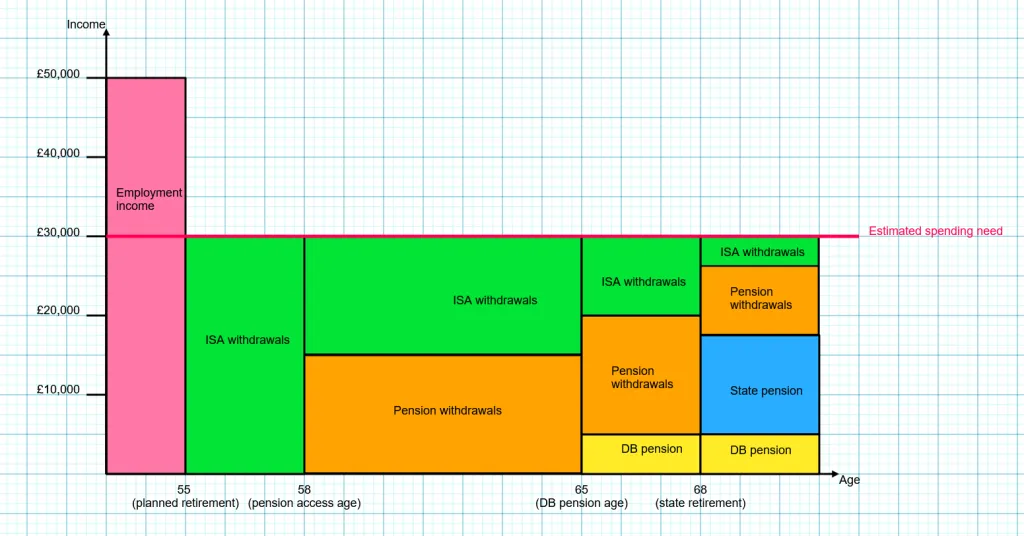
Cash flow planning
Section titled “Cash flow planning”As you approach retirement, you may find it useful to build a basic “cash flow forecast”, using:
- Using exclusively ISA savings before “normal minimum pension age”
- Temporary higher pension withdrawals between “normal minimum pension age” and “state pension age”
- DB pension income replacing some of the ISA withdrawals
- State pension income replacing some of the ISA and pension withdrawals
A properly qualified financial planner can model this for you using software.
An example of a simple visual cashflow forecast:
Notes on parameters/assumptions used for calculations
Section titled “Notes on parameters/assumptions used for calculations”The most important thing to remember is that the parameters you use in your calculations will not directly determine your results – they will only affect your planning.
Investment returns
Section titled “Investment returns”Adjusting your assumptions of investment returns will make a big difference to your overall results, especially if you are young with decades to go before retirement.
Since 1900, investing in equities for a long term has produced an annual, after-inflation return of 4.9%. The caveats:
- There is no guarantee that the next 10, 20, or 40 years will match this average.
- Index returns are gross of any costs (i.e. fund fees, platform charges, any tax paid).
- This average is for equities only. As you approach retirement, you will likely need to reduce the risk level of your investments (see ‘sequence of returns risk’ above). De-risking typically involves introducing bonds as an alternative to equities, which will reduce average returns (in exchange for reducing the risk of disasters).
Withdrawal strategies & safe withdrawal rates
Section titled “Withdrawal strategies & safe withdrawal rates”Background
Section titled “Background”Prior to 2015, there were relatively few options when it came to pension withdrawals in the UK. The default approach was to give your pension savings to an insurance company in exchange for a guaranteed income for as long as you lived (an annuity). In 2015 the rules on alternatives were relaxed further, and almost overnight the default approach became “flexible income withdrawals”. The main risk with flexible access is running out of money prematurely.
Safe Withdrawal Rates
Section titled “Safe Withdrawal Rates”A ‘safe withdrawal rate’ refers to how much income you can safely take per year (generally increasing with inflation) and have a very low risk of running out. Estimates range from about 2.5% to 4.5% – a very wide range. To withdraw £15,000 at 4.5% would require you to have £350k invested, at 2.5% you would need £600k!
Some strategies to consider:
- Consider a range of withdrawal rates, instead of banking your whole retirement planning on a single rate. Ask yourself ‘could I survive on 2.5% withdrawals?’ – ‘how would my retirement change if I could withdraw at 4.5%?’
- You could purchase an annuity with your saved retirement funds, rather than (or in combination with) drawing from them flexibly. This sort of decision is outside of this page’s scope, and professional advice should be sought.
- You could use current “annuity rates” as a proxy for safe withdrawal levels. Just be aware that these rates can fluctuate significantly over time.
- Seek help from a professional financial planner with expertise in building variable models. Terms you want to ask about are “monte carlo forecasting”, “bootstrapping/backtesting” or “stochastic modelling”.
- If you want to learn more yourself, consider some specialist resources such as Beyond the 4% Rule by Abraham Okusanya, or by searching for and learning more about withdrawal strategies such as Bengen’s 4% fixed rule, Guyton-Klinger guardrails, or the Boglehead Variable Percentage Withdrawal Approach.
Retirement age
Section titled “Retirement age”The age at which you plan to retire makes a huge difference to the amount of retirement income you can expect, because of the triple impact for each earlier year:
- One year less of contributions
- One year less of investment growth
- One year more of withdrawals
This applies to DB pensions as well as DC. Retiring early means the scheme pays out a guaranteed income for more years, while you pay in for fewer years – known as an ‘actuarial reduction’, designed so that on average, members of the scheme receive the same total benefit relative to their number of years in the scheme. It is not a ‘penalty’ designed to discourage employees from retiring early!
Related topics
Section titled “Related topics”Planning drawdown
Section titled “Planning drawdown”This page is intended to help plan how much to save for retirement. If you are close enough to retirement to start thinking about your drawdown strategy, you’ll encounter a whole new set of questions and terminology – drawdown, crystallisation, UFPLS, annuities – beyond the scope of this page. Government-backed service PensionWise offer one free pension guidance appointment to over-50s.
Getting professional advice
Section titled “Getting professional advice”See our page on Financial Advice for more info. If you are looking for a professional cash-flow forecast, look for advisers and planners that offer this service specifically, particularly those who hold the Certified Financial Planner qualification.
Inheritance tax
Section titled “Inheritance tax”It is worth noting that whilst pensions are currently exempt from inheritance tax, this is changing in April 2027, which may impact your choice as to how much money you wish to put aside in your pension vs distribute in your lifetime.